I started solo camping when my boys became men and, married twice over to non-campers, I realized I was on my own for the annual summer reset in the wilderness that my soul requires. After a couple of years of returning to a favorite spot in the Trinity-Alps, where I feel safe because I know the territory, I decided I was ready for a new adventure and set my sights on kayaking opportunities in the Sierras.
I found a perfect out-of-the-way lake ideal for kayaking. Determined to dive right into summer at the close of the school year, I blocked off my camping time for the beginning of June. A week or two ahead of my trip I went on-line to confirm my plan only to learn that my destination camping area was not yet open. In the High Sierras the snowmelt continues into July. Die-hard optimist that I am, I decided I would go up and hope for the best, having sussed out a nearby lake and camping area that was open as my plan B. I started my drive still hopeful, calling the ranger station from somewhere in the foothills in the hopes that since yesterday the site would have opened. When I came to the road closed sign, I finally accepted my fate and went to camping spot B.
Sitting at over 7,000 feet, there was still snow on the ground at Lake Alpine in early June. I am a fair weather camper. But I took a deep cold breath, put on another layer, and found a mostly dry camping spot. No surprise it wasn’t crowded. But the lake was beautiful. The kayaking was great. The night was very cold. And I was doing it! I was navigating new territory, all by myself.

The next day it was time to go hiking. I pulled on my boots and hit the trail. Before long I found myself hiking on the snow. Fair weather camper that I am, I’ve never hiked in the snow. The first thing you notice when hiking in the snow is that it’s hard to find the trail. The second is that it’s hard to find your footing. My hiking poles were unhelpfully tucked away in my car and my boots were well-worn hand-me-downs on their last bit of tread. Again, ridiculous optimist that I am, I was certain it would be fine; I could totally find the trail and clamber my way up to the ridge I had chosen as my destination.
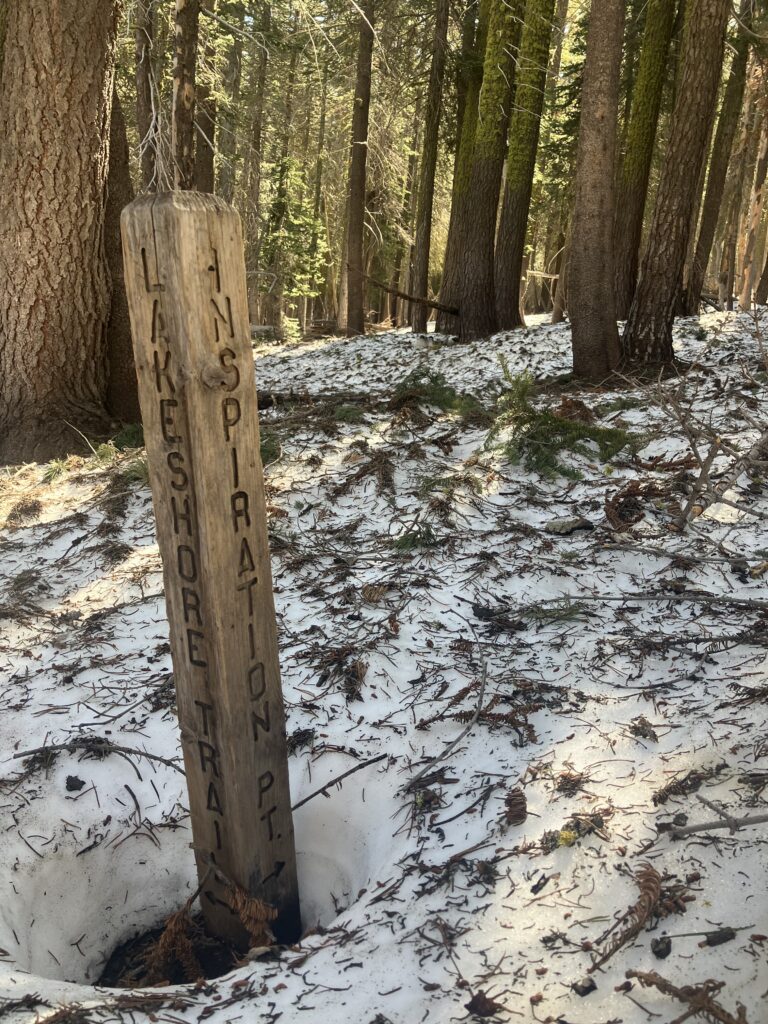
I was maybe halfway up when the place where the trail might have been ran into a huge downed tree. It was as I was clambering around the tree that I finally slipped and fell on my butt. And at about that same time that I took in that I was in bear country alone with nothing but my own foolishness. I wasn’t lost yet because I could always orient myself to the lake, and I knew where I was trying to go, the ridge being obviously up, but hell if I knew how to get from here to there slipping and sliding along on the crusty snow.
When I was twenty-something, I had an REI water bottle that said something like, “You aren’t lost if you don’t care where you are.” I loved the freedom of that sentiment in a season of my life when everything was new territory waiting to be explored. But at fifty-something I’m rather more used to knowing both where I am and where I’m going, on the trail, and in life.
Sometimes, on purpose or by accident, you have to step off the trail. A year ago, I metaphorically slipped and fell on my butt in my worklife. I was completely flattened by a stretch of non-stop labor piled on top of the accumulated effort of over two decades of energized invention and reinvention that I had put my heart and soul into. I was just done. All of my optimism and enthusiasm were drained out of me. I spent the next six months trudging up that hill until I made it to the ridge, where I could quit my job, my career (at least as I had been practicing it) and look out into new territory. I had no idea where I was.
In her book Third Ear: Reflections on the Art and Science of Listening, Elizabeth Rosner recounts a visit to a shaman during a writing retreat in Mexico. She is wrestling with sudden partial hearing loss that feels like a threat to her life’s work as a writer and teacher. In their time together, the shaman, “tries to explain the difference between feeling lost and feeling like I don’t know where I am. That is when I must listen to my heart, he says. I must trust in the sound of the wind, the messages of connection, the voice of Grandfather Fire.”
What is the difference between feeling lost and not knowing where you are? I think being lost is when you legit don’t know where you are or where or how to go from here. But not knowing where you are is finding yourself in new territory that you absolutely belong in, but don’t know how to navigate yet. You haven’t misstepped so much as taken yourself somewhere that requires re-orienting yourself and learning how to be in this new environment.
Spiritual teacher Cathy AJ Hardy teaches that these seasons of disorientation require us to slow down, until we can adjust to our new reality. In order to catch up to where we are, our souls need slow time. We need to wait a minute, or longer, before we get moving. That wait time allows us to attune to where we are, to who we are becoming, to how we might go forward. When we slow down we can hear our hearts, the sound of the wind, the connections that are calling us.
On my butt in the snow I sat there for a minute, laughing at myself, and taking in where I was, and where I wasn’t. Clearly I was not on the trail. I gathered myself and, moving more slowly, with more intention, I picked my way across the crusty snow until I came to a dry patch, and, yes, a trail. That trail led me up to the ridge where I gazed out over the lake I wasn’t able to reach on this trip, the lake I would need to leave for another time.
I have been astonished this winter/spring at just how disorienting it has been to step away from the rigorous pacing of my life over these many years and my place of competency, identity, purposefulness. I set my sights in December on where I wanted to go, and, like that trip, it has turned out not to be as simple, or as up to me and my sheer determination, as I had imagined to get there. All of the whisperings and voices of the universe, from inside and out, have invited me to go slow, to take my time and get to know this new territory. Sigh. When you can’t find the trail and the footing is precarious, what other choice do you have?
Where do you find yourself today? What messages are being whispered in the wind or arising from your heart? How can you slow down enough to take it all in?