
It’s the season of omer counting again. Each spring between the festivals of Passover and Shavuot, (many) Jews count seven weeks for a total of 49 days. In fact, it’s on account of the counting that Shavuot’s date is determined, 50 days after the first day of Passover. Back in the days of the temple, Jews made an offering on Passover of freshly harvested barley. At Shavuot they were commanded to offer freshly harvested wheat. An omer is a sheaf of barley. Basically we are counting from one harvest to the next, enjoying our barley and hoping for a good wheat harvest.
After the exile from Israel, when Jews found themselves with neither a temple nor any harvests, the rabbis laid a new story atop the counting. Clearly Passover marks the Exodus from Egypt (that’s in the book!) so Shavuot must be when we received the Torah at Mt. Sinai. Fifteen hundred years later (more or less), the Kabbalists (Jewish mystics) decided that what counts during this season is our spiritual readiness to receive the Torah again this year. To that end they created a chart mapping seven of God’s attributes onto the 49 days in an overlapping grid so that each week is anchored in an attribute that you are working on that week, with a different focus every day, coming from that day’s attribute combo. For example, week one is focused on chesed/lovingkindness. And each day crosses with another attribute, like strength, beauty, grit so that on that day you are invited to reflect on the intersection of strength and lovingkindness, say.
So what does it mean to count the omer? Just that. We say a blessing and we count. After dinner this evening, we’ll say the blessing that commands us to count the omer and we’ll say it’s day 20, which makes 2 weeks and 6 days of the omer. That’s it. Or at least that’s the mitzvah (commandment). From there you can go as deep as you want to, or not. To support you in this practice you can buy an omer counter, get a daily reflective email, use an activity driven workbook, engage your omer counting card deck, and yes, there’s also an app for that.
For many years I’ve taken up this mitzvah with everything from determined enthusiasm to a dull sense of obligation. I’ve done everything but the app, including making my own (slightly imperfect) omer counter. This year we are counting again at my house mostly because my beloved decided to paint daily reflection cards (which might be as much about the watercolor challenge as it is about counting the omer).
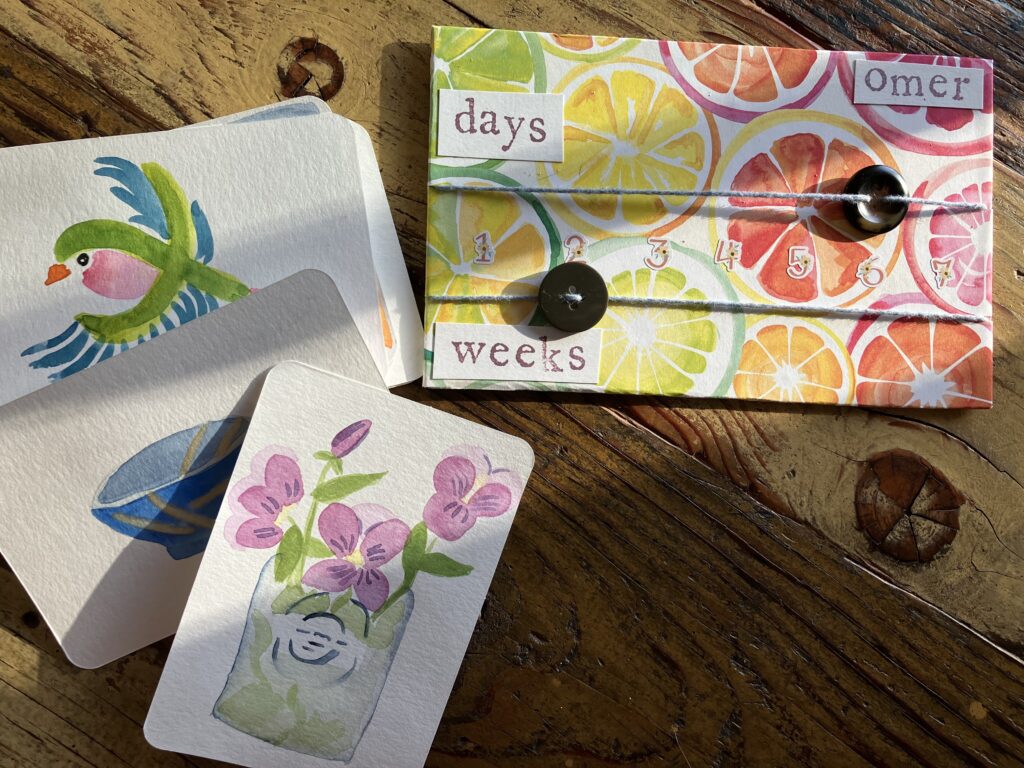
Almost every year (honestly, maybe all of them) I bail out before we get to Shavuot. At a minimum I lose interest, relinquishing my spiritual aspirations and settling for a tired (and tiresome) recitation at dinner each evening. This year I haven’t bothered to muster the enthusiasm. I just started with a “whatevs” kind of obligation and am honoring the art that arrives on my table each day.
In the many years that I’ve taught about this practice to people of all ages, I’ve always circled back to the original commandment, this idea of counting during these harvest days with a focus on waiting for the wheat harvest. I have this idea that the counting started as a way for Jewish farmers to pass the time and manage their anxiety about the harvest. “Is it ready yet?” “Nope! It’s only day 20, which makes 2 weeks and 6 days of the omer. We have a ways to go still.” With each day you can feel the possibilities growing (literally!) and you remind yourself that it’s not ripe yet. Not because something is wrong but because ripening takes time.
This year the omer arrived just as my life plan chart said, “Start a reiki practice.” Up to this point I had concrete steps to do. Rebuild your website, set up your reiki studio, make a marketing plan, start a substack, get business cards, practice, practice, practice. And then it was April and everything was in place, but the practice didn’t magically appear. I started to feel panicky. A little bit lost. Like my ancestors, I started to think back to Egypt where the work was impossibly hard but there was always food on the table. And I wondered, “Am I doing the right thing?”
The spiritual focus for week number two of the omer is gevurah. Like all of the attributes, gevurah has a dizzying array of definitions in this context (You have to be a mystic to understand the omer chart.) all of which relate to strength, one of which is discipline. As a free-spirited Sagittarian I don’t really believe in discipline for myself or others. As a Hebrew school principal I actively avoided creating discipline policies, opting instead for deep community building. But this year discipline landed differently. I heard it not in the sense of getting in trouble or obeying rigid rules, but as a practice, a commitment, a way to cultivate yourself toward who you are becoming. Kind of like counting the omer. A discipline could be the thing(s) you do in the hope that it offers you a supportive structure as you do the hard work of waiting and/or ripening.
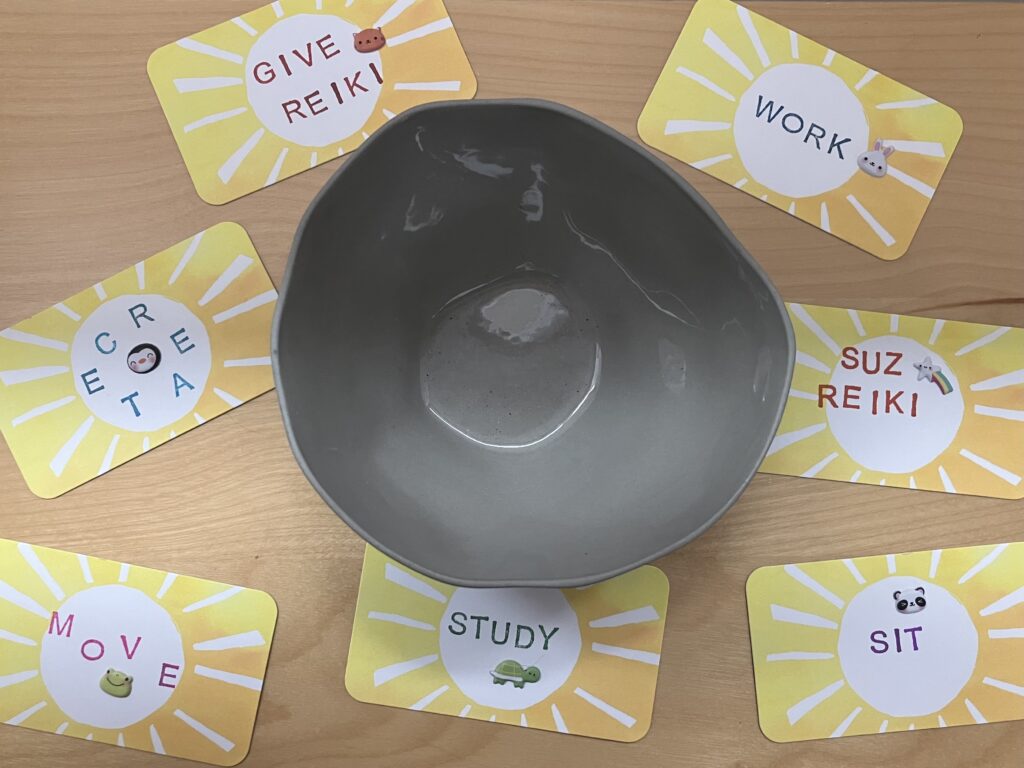
Inspired, I crafted for myself a discipline, a structure for this season, so that each day, as I wait for and work toward the ripening of this new practice, I am held by a set of daily practices that give my days shape, purpose and focus. To hold myself accountable (hello omer counter and cards) I put each practice on a card and designated a bowl for holding them. Each morning I empty out the bowl and through the day, as I complete each commitment, I fill it up again. I don’t know how quickly I will bail out, but so far it’s been one week and one day, and I am relieved and being held by the discipline.
Where in your life is discipline waiting to be invited in?
May a smidge of discipline offer you just enough structure to grow and ripen.