Coming Home to Yourself: A Yom Kippur Sermon
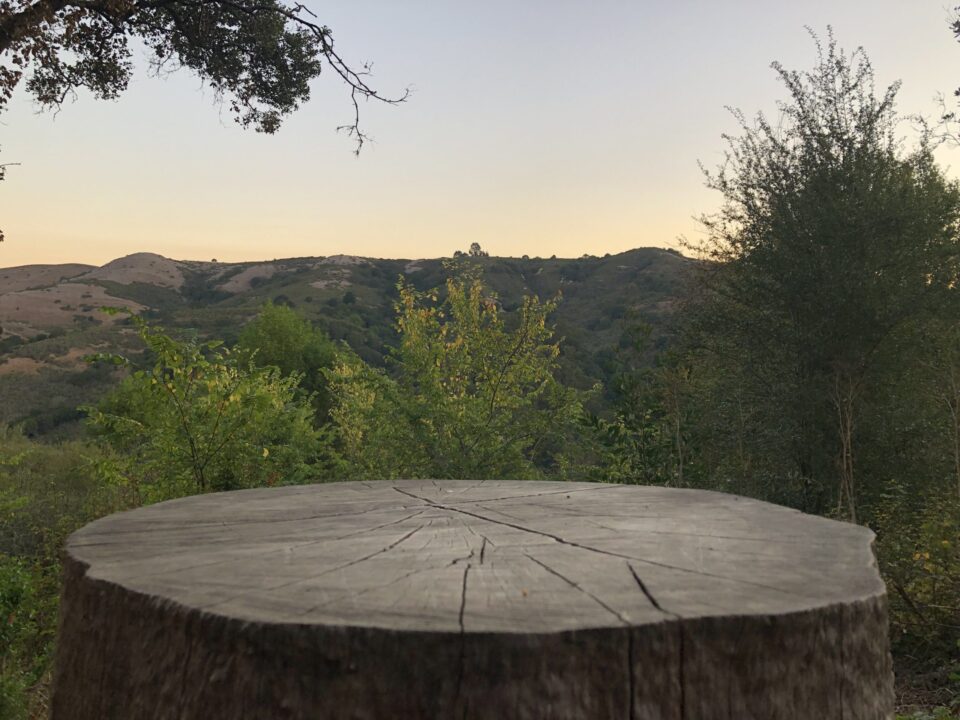
Such Silence – a poem by Mary Oliver As deep as I ever went into the forest I came upon an old stone bench, very, very old, and around it a clearing, and beyond that trees taller and older than I had ever seen. Such silence! It really wasn’t so far from a town, but it seemed all the clocks in the world had stopped counting. So it was hard to suppose the usual rule applied. Sometimes there’s only a hint, a possibility, What’s magical, sometimes, has deeper roots than reason. I hope everyone knows that. I sat on the bench, waiting for something. An angel, perhaps. Or dancers with the legs of goats. No, I didn’t see either. But only, I think, because I didn’t stay long enough. Across the street from my house is a hill and if I go up and up and up that hill, I’ll find myself on a ridge overlooking Tilden Regional Park. A short way along the fire trail on that ridge is a tree stump, cut flat and rubbed smooth by the years. It’s just about waist high for me, easy to clamber onto, and perfectly-sized to hold my cross-legged self. That stump is one of my sacred spaces, a space that I seek out when I need to remember who I am and that I am profoundly connected to the cosmos. And no, I haven’t yet seen angels or dancers with the legs of goats, but I can sit there listening to the natural and urban sounds blend, surrounded by morning fog or shielding my eyes from the sun as it peeks over the hill across the canyon, and I can feel myself sink down into the earth through the roots of this old stump, and extend up and out to the edges of our expanding universe. And I can know with a deep sense of knowing that I am part of the fabric of creation, whole and holy. Where are your sacred spaces? Where do you go to know yourself, to remember yourself? Perhaps like me you can easily tick off a few places. For me it’s also at the edge of the ocean as I lose myself in the majesty and motion of the sea and its thunderous presence. And it’s in the arms of my beloved on a no-alarm morning where I can listen to the birds in the backyard and remember that I am safe and loved. Perhaps those places are harder for you to find. Maybe they are in a memory or a moment in time or in far-flung places that you have touched only briefly. The traditional text we read on Yom Kippur teaches that “God spoke to Moses after the death of the two sons of Aaron who died when they drew too close to the presence of God.” (Leviticus 16:1) God tells Moses to let his brother Aaron know, as if it weren’t already apparent from the experience of his children, not to come into the Holy of Holies, the inner shrine of the Mishkan, our portable desert temple, whenever he feels like it. “For I appear in the cloud over the cover.” says God. (Leviticus 16:2). Then God proceeds to explain the circumstance in which Aaron is invited in, which is the temple ritual for Yom Kippur. Aaron is to bathe himself, put on special vestments, and bring particular offerings – a bull for the sins of himself and his household – and a ram as a burnt offering. God instructs Aaron regarding the two goats, one of which is made into a sin offering to God and the other upon which Aaron lays all of our sins before it is driven into the wilderness. There is blood and fire and a cloud of incense which protects Aaron from the intensity of his encounter with God, “lest he die.” (Leviticus 16:13) At the end of all of this, on this day of atonement, the people of Israel are made pure again. “This shall be to you a law for all time,” the text teaches, “to make atonement for the Israelites for all their sins once a year.” (Leviticus 16:34) A few hundred years later, the first temple was built in Jerusalem and for most of the next 1000 years, this is how we observed Yom Kippur, with the high priest making atonement for us each year. The 13th century mystical text, The Zohar, adds another small detail of this temple ritual, the rope tied around the Kohen Gadol, the High Priest’s leg. “Rav Yitzchak said”, the Zohar reports, “‘One rope was tied to the Kohen’s leg when he went in [to the Holy of Holies], so that should he die there they could pull him out.’” (Zohar on Parashat Emor 102a) So dangerous is it to encounter God with this kind of intimacy, this kind of intensity, that it requires an emergency plan to reclaim the body of the High Priest if he doesn’t make it out alive. Today, on Yom Kippur 5784, our practice has changed but our intention remains the same. Our mission here is to bring our whole messy selves to God, to reconnect with our sense of the divine, with what is holy in us and around us, and to recommit to becoming expressions of that holiness in the year ahead. What might that look like for you? When I lived for a year in Jerusalem as a student in the early 1990s, it was still possible to go up onto the Temple Mount. I was able to enter the Dome of the Rock and see the exposed earth that is, according to Muslim tradition, where Abraham nearly sacrificed Isaac and from whence the Prophet Mohammed lifted off on his journey into heaven. Ultra-Orthodox Jews won’t visit the Temple Mount, even in the seasons when that is politically possible, for fear that they will accidentally walk into the space that is the Holy of Holies, a space…